
Presented below is the text for this coming Sunday for the men to read if they so choose, to meditate on its meaning prior to attending mass. Included is the commentary from Father Lapide for this same text.
The Gospel Text for Sunday, November 10th, 2024 (Note: All of chapter 12 presented below for the sake of completeness)
St MARK 12:38-44:
The parable of the vineyard and husbandmen. Caesar’s right to tribute. The Sadducees are confuted. The first commandment. The widow’s mite.
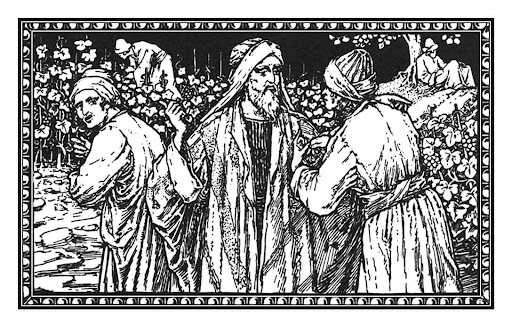
1 And he began to speak to them in parables: A certain man planted a vineyard and made a hedge about it, and dug a place for the winevat, and built a tower, and let it to husbandmen; and went into a far country. 2 And at the season he sent to the husbandmen a servant to receive of the husbandmen of the fruit of the vineyard. 3 Who having laid hands on him, beat him, and sent him away empty. 4 And again he sent to them another servant; and him they wounded in the head, and used him reproachfully. 5 And again he sent another, and him they killed: and many others, of whom some they beat, and others they killed.
6 Therefore having yet one son, most dear to him; he also sent him unto them last of all, saying: They will reverence my son. 7 But the husbandmen said one to another: This is the heir; come let us kill him; and the inheritance shall be ours. 8 And laying hold on him, they killed him, and cast him out of the vineyard. 9 What therefore will the lord of the vineyard do? He will come and destroy those husbandmen; and will give the vineyard to others. 10 And have you not read this scripture, The stone which the builders rejected, the same is made the head of the corner:
11 By the Lord has this been done, and it is wonderful in our eyes. 12 And they sought to lay hands on him, but they feared the people. For they knew that he spoke this parable to them. And leaving him, they went their way. 13 And they sent to him some of the Pharisees and of the Herodians; that they should catch him in his words. 14 Who coming, say to him: Master, we know that thou art a true speaker, and carest not for any man; for thou regardest not the person of men, but teachest the way of God in truth. Is it lawful to give tribute to Caesar; or shall we not give it? 15 Who knowing their wiliness, saith to them: Why tempt you me? bring me a penny that I may see it.
16 And they brought it him. And he saith to them: Whose is this image and inscription? They say to him, Caesar’s. 17 And Jesus answering, said to them: Render therefore to Caesar the things that are Caesar’s, and to God the things that are God’s. And they marvelled at him. 18 And there came to him the Sadducees, who say there is no resurrection; and they asked him, saying: 19 Master, Moses wrote unto us, that if any man’s brother die, and leave his wife behind him, and leave no children, his brother should take his wife, and raise up seed to his brother. 20 Now there were seven brethren; and the first took a wife, and died leaving no issue.
21 And the second took her, and died: and neither did he leave any issue. And the third in like manner. 22 And the seven all took her in like manner; and did not leave issue. Last of all the woman also died. 23 In the resurrection therefore, when they shall rise again, whose wife shall she be of them? for the seven had her to wife. 24 And Jesus answering, saith to them: Do ye not therefore err, because you know not the scriptures, nor the power of God? 25 For when they shall rise again from the dead, they shall neither marry, nor be married, but are as the angels in heaven.
26 And as concerning the dead that they rise again, have you not read in the book of Moses, how in the bush God spoke to him, saying: I am the God of Abraham, and the God of Isaac, and the God of Jacob? 27 He is not the God of the dead, but of the living. You therefore do greatly err. 28 And there came one of the scribes that had heard them reasoning together, and seeing that he had answered them well, asked him which was the first commandment of all. 29 And Jesus answered him: The first commandment of all is, Hear, O Israel: the Lord thy God is one God. 30 And thou shalt love the Lord thy God, with thy whole heart, and with thy whole soul, and with thy whole mind, and with thy whole strength. This is the first commandment.
31 And the second is like to it: Thou shalt love thy neighbour as thyself. There is no other commandment greater than these. 32 And the scribe said to him: Well, Master, thou hast said in truth, that there is one God, and there is no other besides him. 33 And that he should be loved with the whole heart, and with the whole understanding, and with the whole soul, and with the whole strength; and to love one’s neighbour as one’s self, is a greater thing than all holocausts and sacrifices. 34 And Jesus seeing that he had answered wisely, said to him: Thou art not far from the kingdom of God. And no man after that durst ask him any question. 35 And Jesus answering, said, teaching in the temple: How do the scribes say, that Christ is the son of David?
36 For David himself saith by the Holy Ghost: The Lord said to my Lord, Sit on my right hand, until I make thy enemies thy footstool. 37 David therefore himself calleth him Lord, and whence is he then his son? And a great multitude heard him gladly. 38 And he said to them in his doctrine: Beware of the scribes, who love to walk in long robes, and to be saluted in the marketplace, 39 And to sit in the first chairs, in the synagogues, and to have the highest places at suppers: 40 Who devour the houses of widows under the pretence of long prayer: these shall receive greater judgment.
41 And Jesus sitting over against the treasury, beheld how the people cast money into the treasury, and many that were rich cast in much. 42 And there came a certain poor widow, and she cast in two mites, which make a farthing. 43 And calling his disciples together, he saith to them: Amen I say to you, this poor widow hath cast in more than all they who have cast into the treasury. 44 For all they did cast in of their abundance; but she of her want cast in all she had, even her whole living.
The Great Commentary Of Father Lapide
CHAPTER 12
Ver. 1. Planted a vineyard. Gr. ἐφύτευσεν, Vulg. pastinavit. The verb pastinare is especially used of vines. It means to dig the soil of the vineyard, and prepare it for planting vines. So the word repastinare means to dig up vines when they are sterile.
And dug a lake (Vulg.), a receptacle into which the must pressed from the grapes might flow. The Gr. is ὑπολήνιον, i.e., beneath the winepress. For ληνός means winepress. Hence the Arabic translates, and dug a winepress in it. S. Matthew (21:33) uses the same expression. For torcular, or winepress, means not only the actual press itself, but the vat or receptacle beneath the press in which the grape juice was received. This last was said to be dug, or, as in Isa. 5:1, to be cut out.
Ver. 33. And to love one’s neighbour as oneself is a greater thing than all holocausts and sacrifices. Holocausts were sacrifices in which the whole victim was burnt and sacrificed to God by fire. This is what God says, “I will mercy and not sacrifice, and the knowledge of God more than holocausts” (Hosea 6:6). This young man tacitly assents to the saying of Christ, and condemns the scribes, who preferred sacrifices, which yielded profit to themselves, to mercy and the love of our neighbour. And this was why they bade children say to their parents, when they were in need, corban, i.e., oblation (see on Matt. 15:6).
Ver. 34. Thou art not far from the kingdom of God. Thou art not far from the way of salvation, for the love of God and our neighbour is the pathway to heaven. Again it means, thou art not far from My Church, by which, militant here on earth, we go to the Church triumphant in heaven. “Still, as yet thou lackest faith to believe in Me as the Messiah, the Saviour of the world, and to obey My commands, so that thou mayest indeed become a Christian. And if thou wilt be perfect, leave all things and follow Me, as the Apostles have done.” When, then, He says, thou art not far, “He shows,” says Victor of Antioch, “that he was still at some distance, and that he ought to reach forward to that which was before, and seek diligently for the things that were yet wanting unto him.”
Ver. 38. Who love to walk in long robes,—stolis (Vulg.). The stola was an elegant garment, flowing down to the heels. Wherefore the Scribes wore it for the sake of ostentation.
Ver. 40. Who devour, Gr. οἱ κατεσθίοντες, i.e., who altogether consume and lick up the houses of widows, both by reason of the sumptuous feasts which they ask of them, as well as by the gifts and money which they avariciously extort from them under the pretext of offering prayers for them. “When, therefore,” says Bede, “the hand is stretched out to the poor, it is wont to help prayer; but those men passed whole nights in prayer that they might take from the poor.”
These shall receive greater judgment. A severer sentence of God, and a heavier condemnation shall press upon the Scribes in the day of judgment, because by a pretence of probity they are aiming at wrong-doing; and being clothed in the garments of God, they are fighting on the devil’s side. “Simulated holiness,” says S. Chrysostom, “is a double iniquity.”
Ver. 41. How the people cast money: æs, brass (Vulg.), i.e., all sorts of money, whether brass, silver, or gold. For the first money was made of brass; hence all money was afterwards called brass, even when made of silver or gold.
Into the treasury; gazophylacium (Vulg.). For gaza is a Persian word, meaning riches; and φυλάττειν is to keep. This was a chest into which gifts were cast by the people, and kept for the service of the Temple, and for supporting the priests and the poor. Hence, also, the porch in which the chest was kept was called by the same name. Thus it is said in John 8:20, “These words spake Jesus in the treasury (gazophylacio), teaching in the Temple.” So Bede.
Ver. 42. A certain poor widow cast in two mites, which make a farthing. Not as if one mite made a farthing, as Euthymius understands, relying on Matt. 5:26. But two mites were equivalent to one farthing, as is here clearly expressed. For a farthing was the fourth part of a little ass; and ten small asses made a denarius. A mite was half a farthing.
Ver. 43. This poor widow hath cast in more than all. For although per se, and other things being equal, the greatest and best alms and oblations is that which is most, yet, per accidens, when other things are not equal, the greater alms is that which is offered with the greater devotion of charity and religion. For God does not so much regard the gift as the disposition of the giver. Again, the greater gift is not that which is of the greater value considered in itself, as that which is the greater and more difficult in respect of the giver.
This widow, therefore, in giving a farthing, gave more than all, because she gave all that she had, although it was necessary for her life. And she would have given more if she had had more. For she trusted in God, that He in return would be more liberal to her, and provide for her necessity, according to the saying, “Give God an egg, and receive a sheep.”
Others truly gave of their abounding superfluities, as Christ here says. As Titus of Bostra says on Luke 21:3, “With such magnanimity and devotion did she offer two mites, that is, all that she had, as if she counted her own life as nothing.” S. Paul gives the a priori reason (2 Cor. 8:12), “If there be a ready mind, it is accepted according to what a man hath, not according to that which he hath not.” As Victor of Antioch says on this passage, “For God does not so much consider the greatness of the gifts, as weigh the greatness and alacrity of the mind.” And Bede, “He weighs not the substance, but the conscience of the offerers.”
For, as S. Thomas says, inasmuch as the widow gave according to her ability, therefore it was the greater affection of charity which was valued in her. S. Ambrose thought the same (lib. 2, Offic. c. 30), “The two mites of that widow surpassed the offerings of the rich, because she gave all she had; but they offered only a small portion of their abundance.” Whence he infers, “The disposition therefore makes the offering poor or valuable, and sets their true price upon things.”∎
NOTES: Gospel text copied from from Online Dhouay-Rheims https://drbo.org/chapter/48012.htm and EWTN Daily Mass Calendar: https://www.ewtn.com/catholicism/daily-readings/2024-11-10


Leave a comment